

What AI quietly edits out of your voice
When smoothness starts to feel like improvement, your writing can lose the cultural architecture that makes it yours. You cannot protect what you haven’t named.

AI can make a certain kind of polished English feel like better writing.
This is about what happens when we let that smoothness sand away the words we reach for, the rhythms we inherit, the languages and memories we carry, and the odd little turns of phrase that make the writing ours.
Before you ask AI to improve your writing, name the parts of your voice that are not errors to be corrected, but evidence of where you come from. Tell it what must be protected.

A passive comprehension of Nepali sits in my brain, although I cannot speak it beyond a few basic words and phrases. I can sing O Christmas Tree in German, Silent Night in Swedish and a random song in Russian I learnt years ago and cannot seem to evict from whatever dusty little neural filing cabinet it lives in.
For almost 24 years, I’ve tossed out a Romanian oeleu! as an exclamation (recently gently adjusted to aoleu! thanks to Mia Kiraki!). I codeswitch at home into words or phrases I really like from languages that have wedged themselves into my life because English, for all its muscle and reach, sometimes just does not carry the same power or feeling.
There is just so much more strength in a nyet or nein than a simple no.
I don’t speak any language with any kind of fluency except English.
A British accent followed me for large part of childhood, and my parents swear it comes to the surface again when I’m tired. My Kiwi accent is mild, possibly as a result. There have been comments when stumbling across homesick Kiwi in the wild, that my accent is not quite a strong reminder of home, but good enough.
I’m not grabbing at languages as passing fancies I collect because they sound interesting and make me feel like a global citizen. Every single item I have mentioned above forms part my identity, my experiences, who I am. My story.
Much of this never makes the page directly, but it is indubitably underneath forming the foundations. It’s deeply personal and echoes off the walls in my world.
Which is why a song has been on repeat in my home and I cannot let it go. It undoes something in me every single time.
Stan Walker has been in my peripheral vision since he was an awkward 18-year-old Kiwi auditioning for Australian Idol in 2009. He had my vote every week and I was elated when he won. Now Stan is all grown up and one of the most powerful examples I know of a proud Māori who stands in his cultural heritage without apology, with a voice honed and crafted to something almost indescribable.
I AM is a song about refusing to let anything - colonisation, assimilation, expectation - dissolve what is fundamentally and irreducibly you.
Cultural identity is deeply intertwined in language, carrying traditions, found in specific expression, particular ways of saying that cannot be translated without loss. The song is in both English and Māori. You don’t need to understand the words to catch the heart. Sometimes meaning moves before translation gets its shoes on.
When a Māori person introduces themselves, you do not just get their name. The pepeha (introduction) carries their genealogy and identity. Their story. You know their mountain, their river, their marae (meeting house) and who they descended from. You get the architecture that holds the name. Strip all of this out and the name is still technically there, but it could belong to anyone.
In the twentieth century, te reo Māori (the Māori language) came terrifyingly close to extinction. A people were separated from their language through successive policies to assimilate Māori to a New Zealand European society not of their choosing.
I’m treading so very carefully here.
My blood is Pākehā, a European New Zealander.
My beautiful grandfather, Wiremu, was Māori.
He adopted my mother, grafting her into a family that can trace its heritage back centuries to the first waka (canoe) that arrived on New Zealand shores from Hawaiki.

This history matters deeply to me. It is also not mine to wear like a feather cloak.
I do not get to claim his loss as my own nor stand in the centre of a pain I inherited proximity to, but not the lived experience of. I cannot make colonial assimilation a metaphor and then wander off with a tidy point about AI like I have not just walked across sacred ground in muddy boots.
Yet here I am, doing it while trying not to. There is no version of this conversation that avoids it entirely.
What happened to my grandfather was not voluntary.
What happens when I let AI smooth my voice is.
These are not the same thing. They are not the same harm, the same history, the same violence, or the same theft.
They do, however, share one mechanism that I cannot stop seeing everywhere I look.
Dominance is very good at making itself feel practical.
Wiremu grew up in an era when his cultural heritage carried shame. When being Māori was something to be educated out of. He watched te reo start to die in his lifetime through the subtle mechanism of assimilation. A repeated lesson that his culture and language were obstacles to the life he was told he should be living. What was framed as common sense created damage.
Wiremu knew how to fish and plant his garden by the phases of the moon. My father often woke up to a tapping on his window at 4am with a “Boy! You awake? Time to fish!”. Eager to impress the father of his future wife, he would often spend a couple of hours out at sea in a small boat fishing, before heading off for a day at work.
Wiremu was also a talented wood carver in the traditional way, and he was known for his huge vege garden at the edge of town. All of his daughters have crazy green thumbs. They can grow anything.
None of them could tell you the moon phase that says it’s time to plant.

Wiremu’s brother-in-law, Ron, was Pākehā. It mattered to Ron to learn Māori because of the community he loved and lived in for decades. His choice was rare. I will never forget the day, as an old man, he formally welcomed a group of my cousin’s colleagues into the house in fluent Māori. The way their jaws dropped as a 92 year old held conversation in a tongue not his own. The way he showed proper respect for their heritage.
I asked Ron afterwards about Wiremu. What was his Māori like? “Terrible!” Ron said. “Are you sure?!” I asked. We chatted about it briefly and then Ron moved outside to work in his vege garden.
I called my Mum to tell her about Uncle Ron and asked if she could remember her Dad speaking te reo. Maybe Uncle Ron was wrong. She said they only ever spoke English at home.
The contrast still sits with me now. A Māori man who could not speak his language very well, a Pākehā man who could and had opinions about it. A Pākehā man held what a Māori man had lost.
A daughter who never really knew the cultural line she was welcomed into.
A granddaughter now writing about it, arguing that voice is a structure that holds the knowledge, and that we should refuse to let it be smoothed away. I’m trying to put my hands around the shape of a loss without pretending it belongs to me in the same way.
I mourn what my grandfather lost, what generations after him have clawed to get back and how very tenuous a position the Māori language still holds even after decades of intentional revitalisation.
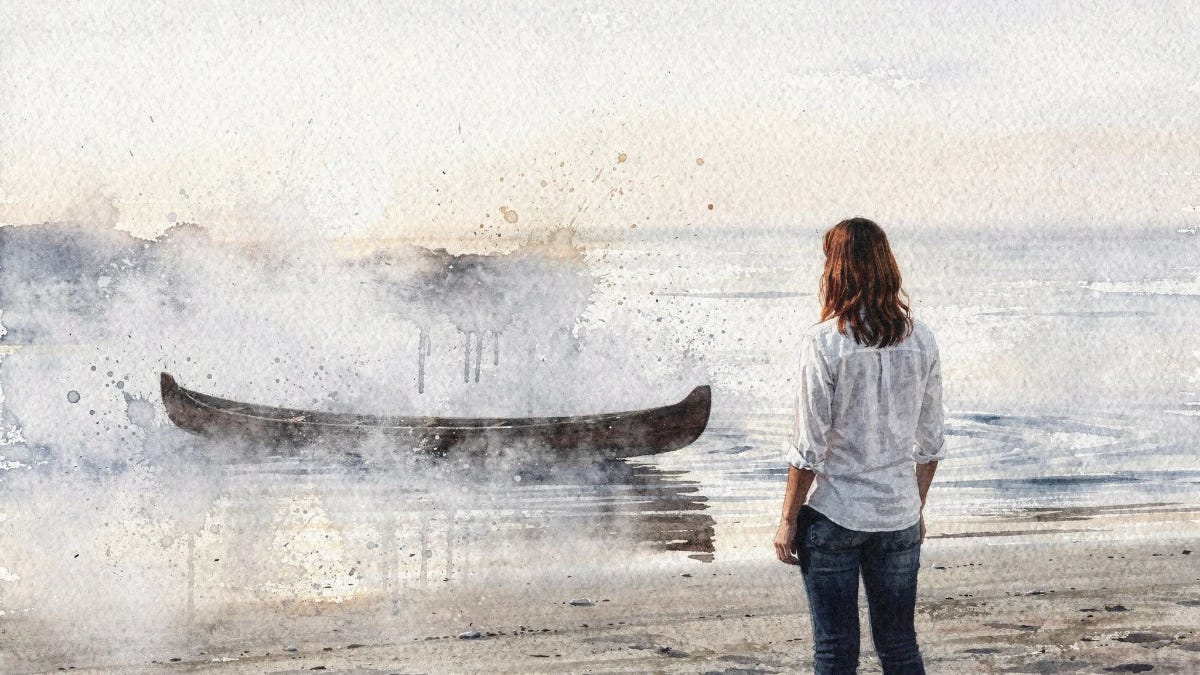
I look at the way I work with AI and feel something poking at me. It’s not the same thing, but there is still an uncomfortable poke.
When context is absent, AI defaults to the dominant constructed English at its centre. A sensible default. Not through the violence of colonial assimilation my grandfather experienced, but the subtle mechanism of making the dominant feel like the sensible choice.
There is no law, schoolroom enforcement, punishment or shame.
Just convenience. The easy little tug of a language style that seems sensible because it sounds like what the machine has seen most often. It presents the smoothness with a confidence that draws us in.
There is a strange conversation happening in New Zealand at the moment. We’re talking about making English an official language of New Zealand. The language of colonisation, the most commonly spoken language apparently needs to be made official and now is the time. The English Language Bill is currently working its way through the legislative process in Parliament.
What would this Bill actually do?
Well, it’s pretty brief as far as Bills go. Five lines in total. It asks for the English Language Act 2025 to be enacted. Nothing more.
It will change absolutely nothing except fulfil an election campaign promise. It’s being described as just common sense.
Five lines to declare something that was never under any threat. Never needed protecting. Already dominant and everywhere in New Zealand. The language I speak.
This is where the AI part starts to shout. No one is making me accept the smoothed version or standing over my shoulder saying, “Dallas, please remove the weird metaphor about the dusty neural filing cabinet and make this more universally acceptable.”
I’ve written about what happens when your process restructures itself without your awareness.

Although this is something quieter than that – this time it’s not about how you work, but rather who you are on the page when you do.
It is only me choosing where I sand down the Kiwi inflection, the odd metaphors, the physical comedy, the emotional specificity, the tiny language fragments that carry my family, the things I’ve read and places I’ve been, the people I’ve met and my particular ridiculous way of being alive.
I do that. It’s called polishing a draft and forming it into a shape I hope you’ll love to read.
Sometimes I’ve even called it better, although better for whom and according to what exactly?
Colonisation used external force. What we are doing with our writing voices in AI is voluntary, even though it has a pull. No one makes us. We call it efficiency.
I’m learning to recognise the pull that happens when I sit down to use AI. The pull toward a levelling, an output that is clear, widely acceptable, could have been written by anyone but nobody’s grandfather.
I’m learning to identify what doesn’t carry the specific weight of a nein over a no or hold the particular shape of how I, specifically, respond or say a thing with feeling. When “aoleu!” is thrown across the room because a particular language in my story has a better sound for that moment.
Wiremu did not choose assimilation, it was chosen for him by a system. He watched te reo Māori decline through the political policy of making his language feel like an obstacle to the life he was told he was supposed to want. He was told, in a thousand ways, there was no future for Māori who clung too tightly to their culture and language.
I’m not Wiremu and I’m not Māori. I have not had anything taken from me that I did not hand over willingly.
When we accept the AI output that smooths our language, when we let the architecture dissolve in the name of efficiency, we call it practical. It’s labelled progress.
It’s just plain common sense. Five simple words.
You have a voice, a way of thinking and a particular knowing you’ve built over your lifetime. Family, place, work, embarrassment, grief, private jokes, favourite phrases, childhood oddities, books you swallowed whole, songs that undid you, and all the tiny linguistic fossils you carry maybe without realising.
Nobody needs to write five lines for it or declare it official. Now AI arrives offering an easy default. A new dominant corpus. Instead of protecting what’s actually ours, we find ourselves feeding it into the machine and wondering why the output feels a bit flat and we can no longer see the shape of our lives in it. The sentences work but do not hold our weight. The shape is technically there but could belong to anyone.
Te reo Māori survived because people fought for it deliberately. With intention. Every single day. They keep fighting.
My grandfather lost the frame of his cultural identity through his lifetime. He was told there was no choice. What I get from being near that history is not the loss, but the ability to recognise the mechanism when I see it working on me. I do not want to casually hand over the frame of my voice because the machine offers me something tidy. Knowing what it costs to have no choice is what lets me see I have one.
Do you know your own voice clearly enough to notice when it’s gone?
Take five minutes. No AI, editing or audience.
Write down the words, phrases, expressions and linguistic oddities that are specifically yours. The ones that carry a person, a place, or a memory. The things you’ve maybe started sanding off.
This list is your baseline. You cannot protect what you haven’t named.
Then, read this:

Work through Part One and Part Two of the Capability Skill Builder. Add in what you need to protect.
My voice is still here. I write this within its architecture. Protect it fiercely from a creep I sometimes cannot see.
Is that enough? I genuinely do not know.
It is something though.
This is Daring Next and we’re absolutely not waiting until we have it all figured out.
Officially → field notes from the uncharted middle of AI adoption.
Actually → dispatches from someone trying to stay human while a very confident artificial intelligence keeps offering to think for her.
New? Start here.
If you would like to support my work without a paid subscription, here is one easy way that you can. Dhanyabad!
The aoleu made me smile 😂❤️ and then the rest of this undid me!!!
I grew up between Romanian and Spanish and English and Armenian and there are feelings that only exist in one of those languages and nowhere else.
My Armenian grandmother had so many words for feelings tht I've never been able to translate and I've stopped trying. When I write in English I carry those untranslatable things underneath and I think that's part of why my writing sounds like it does.
AI has no access to that layer. It can mimic the surface but it can't carry what lives below it.
Thank you so much for this piece and the beauty of it! 🥰
Such a beautiful and deeply reflective piece, Dallas! I love how you've weaved together your grandfather's heritage with the habits that we now form when interacting with AI. Very good reminder that our unique voice holds a piece of history, and we shouldn't casually trade it away just because a machine offers a tidier sentence. Thank you for writing this. 🩵