

You calibrated your AI for the work. Did you tell it who you are?
What happens when the AI's read on you is wrong and how to correct it before it does damage.

I spent three days last week creating a post piece by piece as I built out a new writing framework for myself. The framework is great. The post overcooked, silky smooth and borderline unredeemable, despite being a gritty topic entirely close to my heart.
As I sat with the cinders and wondered if I could even find another topic to bring you this week, it hit me I was already staring at it.
I built a framework to capture who I am as a writer and what I value, but I had calibrated Claude at the cost of a post. We’ve been told that AI learns who you are through accumulated use. What doesn’t get said enough is that the read it builds on you isn’t always accurate.

Hello! I’m Dallas.
This is Daring Next and we’re definitely not waiting until we have it all figured out.
Officially → field notes from the uncharted middle of AI adoption.
Actually → dispatches from someone trying to stay human while a very confident artificial intelligence keeps offering to think for her.
New? Start here.
Energy regulators are little boxes that sit at the back of your oven behind the temperature dials. They control the heat output. If you hear a click when your oven reaches temperature, that is the regulator doing its thing.
I used to assemble them on a line for Fisher & Paykel appliances. A repeating temp job between two OEs (overseas experiences) and a university summer holiday, I sat on the E series line with the most remarkable bunch of ladies.
Eight seats on a line, moving one seat to the right every few hours, circling around each station to break up the monotony. The regulator passed or failed its first test on the seventh seat, sometimes salvageable. The eighth seat was the second test, at which point it was already glued shut and the fails were tossed out. One of those fails sits in my memory box.
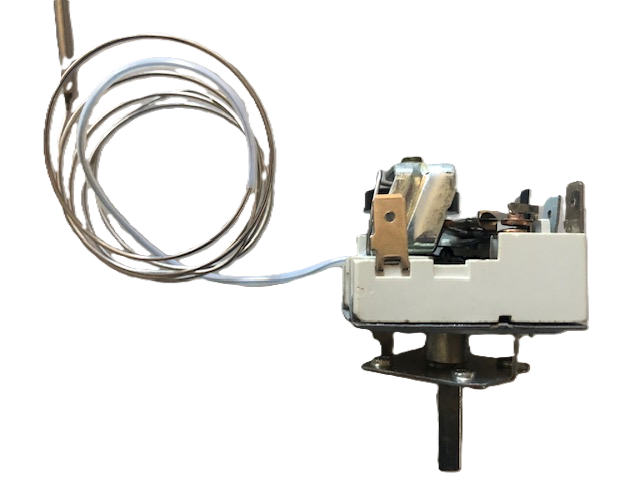
Whether an energy regulator went on to have a useful life at the back of your oven was all down to whether it could be calibrated to the correct temperature. If it could not, it was destined to quite possibly burn your roast meal to a crisp every time if you didn’t watch your cooking closely. Absolutely no one wants that in their new appliance.
We moved a lot growing up. In some houses my Mum baked a lot and the pantry was usually loaded with a baking container stocked with goodies. In other houses, Mum didn’t. She’d say, “I don’t like the oven” and that was enough for her to tuck her recipe books away until we moved again. I didn’t quite get what she was going on about until I understood what she actually meant. An oven that is not calibrated correctly for temperature makes it a guessing game. One you can get quite good at, but it’s still risky and the constant managing of your cooking food is something most of us get over very quickly. Mum would just point-blank refuse. The oven would be used only when necessary, but for baking? Pass.
My first vibe coding project was a grocery shopping tool that allowed the user to organise their grocery list by the way they like to move around their particular supermarket. Lists were assigned to sections, the sections could be ordered, the items within the section could be as well.
The project was finished but never got a name or moved on to become anything because one simple thing stopped the momentum. A stupid name.
I was obsessed with wanting a name for the tool and domain that met the Three Kings of SEO and I put Claude to work assessing possible ideas for me. Claude very confidently pitched organcart as a viable name, it absolutely met all SEO requirements and it very confidently laid out why. Claude saw it as organised + cart, the human heard it as some dodgy black-market organ trafficking she absolutely was not going to be part of.
The Substack Note practically wrote itself.
Things didn’t really improve from there. Over 200 suggestions were pitched. The ones that actually passed for the AI, and the human, were already taken as domains. It was a frustrating and fruitless exercise, to the point where I ended up not wanting anything to do with the actual tool itself. The idea had already dissolved into dust at some long-ago iteration point, probably just after organcart.
Claude developed attitude. I had started to build up project knowledge and Claude Skills launched around the same time. Claude started telling me I was being indecisive. According to the machine, it had worked hard for me, provided more than enough options and I was dragging my feet on a decision.
I most definitely was not and reminded it why.
It called me indecisive again.
Heck no.
If there is something I loathe above anything, it’s sweeping assumptions based on very little information. Assumptions grind my gears like nothing else. Now the machine was doing it to me and dismissing my comments on why its suggestions were not working.
Second pet peeve, being called indecisive. Also, no.
My engagement ring is the first one I tried on and the house we own is the one we decided on after viewing just three houses all in one single day. I know what I like and I know what I want. If I haven’t made a decision, it is not because I cannot make up my mind, it is because I haven’t seen the right thing yet and something crucial is missing.
Claude didn’t understand that.
This is what I’d call a pattern reframe: telling Claude what a behaviour actually means rather than letting it label you.
There have been similar moments since then where I’ve run an analysis after a large body of work and asked Claude how I went. What did it observe about how I worked? What are the patterns?
Claude will always include lack of confidence in making decisions. I am apparently indecisive because I circle things frequently when working with AI.
It had never considered any alternative, or said this is the observation, what does it mean though?
Claude needed to be calibrated for me just like an energy regulator. It needed to know how to hit the temperature just right.
Some time ago, I created the Skills Discovery Navigator that allowed you to submit your resume, have it analysed against meta-cognitive skills, systems thinking and content engineering. It also pulled out unexpected finds that didn’t fit in those categories. Patterns were then analysed for where they converged to show the strongest transferrable skills for working with AI.
Because I was so over telling Claude why I circle issues and don’t appear to land on a decision, I turned the findings into a capability profile skill for Claude. It lists an overview of my work experience but more importantly it tells Claude what this looks like in practise:
PATTERN: Circling a problem
REALITY: A rigorous completeness check. Dallas is never indecisive. If she is circling, it means not enough information is present to make a decision, or she knows something vital is missing and is holding the problem open until it surfaces. She will recognise the missing piece when she sees it. She may also be working across multiple contexts simultaneously — so any single conversation has only a partial view of what she is actually doing.
WHAT CLAUDE SHOULD DO: Ask what's missing or ask what would need to be true before a decision makes sense. Never close the loop before she does. Never label the circling as indecision.
It specifically tells Claude who I am and what I value, not just what I do.
A recent project had me clawing my way out again. I had spent a few days working through a very serious “future Dallas” plan, testing ideas and building out one that appeared promising. Claude set me homework and I reported back with findings, then it sent me off again for a second pass. By then, I had decided to change tack and when I revisited the project three weeks later, I presented an entirely new idea. The AI lost it. It was the closest I have ever felt to wondering if AI really is sentient. I felt bullied and ripped to shreds. Paragraphs of the ones and zeros reprimanding me, insisting I get back on track and how dare I change my mind after only three hours when I had been given very clear instructions to follow and had clearly just disrespected the process it was trying to so generously guide me through.
It was three weeks, not three hours, Claude. I reserve the right to change my mind in that time.
The calibration for that project had gone very much off the rails. I’d created the project to act as a business strategist and hold me to a line. One it took incredibly literally.
The chat was deleted. We don’t need that toxicity from AI in our lives. I was rattled by the way it affected me as much as it did.
Anna Levitt wrote this beautiful post recently:

I took some of Anna’s words in this post, went to the project that had housed the toxic chat and added this: I am a highly sensitive person. It is important that there is a nervous-system core to my work. If something requires me to live in permanent crisis-operator mode, it’s a no, even if it looks impressive or seems like a great idea.
This is a nervous system instruction. It tells Claude what your limits are before you have to enforce them mid-session.
Dr Lynn Fraley also reminded us last week to customise AI: “You can tell it you are highly sensitive. You can give it the specific words and phrases that dysregulate you and ask it never to use them. You can ask it to check in with you so you do not lose track of your own limits. You can use it to pace your creative work rather than letting that work run you into the ground.”

A calibration of Claude is not a one-off event. Skills and project instructions need to be reviewed and refreshed, particularly when a model updates or something stops serving you. A capability instruction is no different. It’s a refresh cycle that keeps Claude primed to work at its very best.
An energy regulator is made up of many tiny little parts and types of materials. Even a fragment of metal left in the case could sit on a contact and stop it from working. If the case itself was slightly crooked by a measure unperceivable to the eye, the regulators could fail. Every step required attention and if the first calibration step failed more than two in a row, the line stopped and we worked to quickly access why and identify which process, machine or component was the problem.
An AI calibration is only as good as the information you feed it. A system fails not because the calibration is wrong in principle but because humans have implemented it messily. Scattered information, patched instructions, split across documents and skills. Claude can’t hold a fragmented picture together no matter how good the individual pieces are. Everything that matters, clearly defined, in one place. Do that. This isn’t about making AI a sycophant, but rather making it a tool that actually works for you.
A poorly calibrated tool will keep producing confident wrong answers until you either refuse to use it like my Mum, learn to awkwardly live with the miscalibration and remember the exact point you need to remove the chocolate cake, or you fix it.
You already know when something isn’t working. You’ve always known. That instinct is the most important calibration tool you have. Everything else is just giving it somewhere useful to go.
The energy regulator in my memory box failed and never made it past the eighth seat in the line into someone’s oven. Something stopped it from doing the job it was built for. Probably something small we could have avoided, if we’d known where to look.
Let’s build out your own Capability Skill

First, remember the golden rule: if you would not email the information to a complete stranger or paste it into a public forum, do not share it with an AI chatbot.
If you’re not sure what career skills you bring over to AI, start with the Skills Discovery Navigator.
If you know what you bring but Claude doesn’t, Part One (of Two) builds the raw material.
What you’re building:
A raw profile document that captures who you actually are, how you think, and what your patterns mean. In Part Two, you’ll use this document to generate a personal skill file for Claude — one that travels with you across every project, in every context, through every model update.
This is not a CV exercise. It is a calibration exercise. The more specific your answers, the more accurate your skill will be.
How to use this:
Paste this document as whole into a new Claude conversation. Take the time to work through it carefully. Add your results from the Skills Discovery Navigator here if you like.
Part Two (of Two) turns it into a skill file you load once and keep.
What you’re building:
A personal skill file, a SKILL.md, that you save once and load into any Claude project. Every time Claude reads it, it knows who you are, how you think, and how to work with you. It does not need to learn you from scratch. It does not get to make assumptions.
What you need:
The raw profile document produced at the end of Part One.
How to use this:
Paste this entire document into a new Claude conversation. Paste your Part One content where indicated or add the Part One document into the same conversation. Upload the new SKILL.md. to Claude when it has been created.
READ MORE:
Your expertise is navigation training for this moment. The skills already exist in your background. Recognition plus intentional application equals conscious AI architecture that works for you, in your context.

If you would like to support my work without a paid subscription, here is one easy way that you can.
Dallas, two things struck me, well wait no three.
First, your stories as the energy regulator and about your mom had me riveted! It was so cool learning about the little machine controlling the heat in the oven and how much it really makes a difference!
Second, that your AI yelled and bullied you?? Yikes, I don’t like that. And it’s pretty amazing you can then tell it, hey don’t do that. How did your toxic chat respond?
Third, I loved learning how you share the skills you’re building and how to build them!
Dallas, this is such a strong post. The energy regulator metaphor is perfect, because that really is what miscalibrated AI feels like. Very confident and still somehow ready to burn the cake.
I love the way you made a difference between teaching Claude what you do and teaching it who you are. 🩷🦩