

AI and highly sensitive people: what happens when your nervous system meets the machine?
Five highly sensitive people on what AI means to how they think, create, and keep showing up.


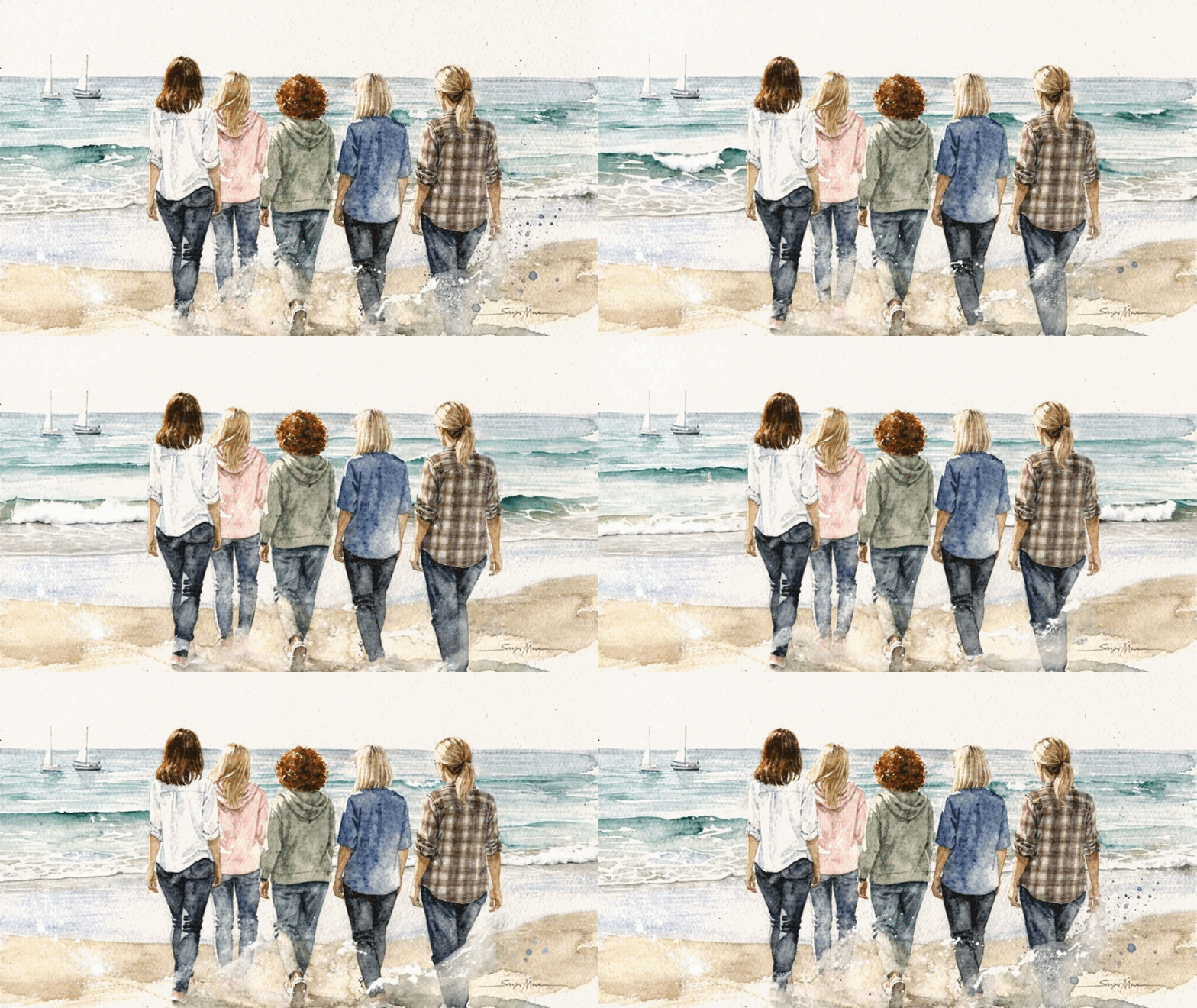
Information overload, depth-processing, high empathy and the need to find stillness when everything is loud. AI, by nature, is none of those things.
What does sustainable work look like when your nervous system processes everything more deeply?
The AI tools we reach for don't ask that question.
Is that friction? Is it useful? Is it corrosive?
Five highly sensitive people and five different relationships with the same tools. One conversation about what it actually feels like from the inside.
I asked one question: What has using AI been like for you as a highly sensitive person (HSP), and what have you learned about yourself in the process?
This is what we have to say.
The term Highly Sensitive Person (HSP) was first coined by psychologist Elaine Aron in the 1990s and has since become an established, scientifically recognised personality trait.
Approximately 15-30% of you reading this are highly sensitive people. It means that your very normal, healthy brain is genetically wired to process stimuli differently. HSPs have a temperament trait called sensory processing sensitivity. This is not a disorder but a distinct neurological way of experiencing the world.
If you are reading this and cannot relate, that is completely fine. You may recognise someone you love in what gets shared here. Even if you are not an HSP yourself, much of what follows may still resonate.
This is not a conversation about neurodiversity. While some traits may look similar on the surface, the brain activity behind them is different.
I first heard about high sensitivity in an Instagram post from a person whose life looked chaotic. My impression at the time was that she just wanted to feel special. A family member then labelled her completely out-of-control wild child as highly sensitive and I was not impressed. So, when I was sitting on a therapist’s couch in late 2019 with my life imploding and anxiety tearing up my brain, and she suggested I read Elaine Aron’s book because she thought it might help, desperation meant I brought the book and devoured it despite any misgiving.
I’d had no idea I’d been a poorly functioning HSP my entire life until that moment. It was not the key source of the state I found myself in at that time, but learning how to regulate myself as an HSP, how to be kind to myself, how to protect myself from a world that can feel too loud and too much? It changed everything for me.
I finally understood why sad things make me cry, happy things make me cry, beautiful things make me cry, and sometimes I just feel something deeply and the tears arrive before I’ve even worked out why. I understood why I absorb the emotions of the people around me at a level I cannot explain. Huge, deep heart conversations are my jam. I cannot tolerate caffeine because my brain absolutely does not need more stimulation. I was constantly told growing up to stop being so sensitive, so I shoved the emotion and overwhelm way down inside until it became normal-ish and no one said that anymore. Sometimes I just know things, not because I have a sixth sense, but because my brain is constantly scanning its environment, picking up tiny subtleties, processing all of it very fast. I see connections easily.
If I go out for an evening of socialising, I will need to take almost equal time when I get home to sit on the couch with a hot drink and a relaxing movie. No matter how wonderful the night was, or how late it is, I make it even later in order to come back to a sense of balance before I can sleep. I call it bubble time.
Now, we find ourselves here in this odd new era with AI and I’m not quite sure what to do with it as an HSP. My brain is firing creatively at a level I have never experienced ever before. Feeling inspired all the time is absolutely mind-blowingly cool. It feels exhilarating. On the flip side, if you told me that tomorrow all technology would stop working and I would need to revert to a phone-free, computer-free life, I would be totally down for that. Perhaps even throw a party.
Inspiration and exhaustion often compete in my brain. One part wants to go endlessly fast doing all the things, the other part desperately needs everything to stop for a beat so it can think straight again. I work hard to set an intentional slow and steady pace, while staying aware of the pull in both directions.
The rate of AI change is simply not sustainable for any of us. The smoothing out of identity and diversity bothers me greatly. I sense a brain change I cannot quite name and feel unsure how to manage it. I don’t know who I will become if I keep using AI.
That uncertainty is what brought me to this conversation.
I reached out to a few friends and asked them if they would like to join me in a discussion. They were not names chosen at random, but rather people I have connected with on Substack who represent a diverse skill set all using AI in different spaces as highly sensitive people. A new friend, Dr Lynn Fraley, joins us. She brings many years of clinical practice as a psychologist who has dug far deeper than many in her profession into how humans are wired and what we actually need to thrive at the soul level.
I’m so excited to share this with you.
Each writer was also asked to share practical tips they swear by for when life gets a little too overwhelming or practises that help them do the work and go through life in a healthy, functioning way.
These are mine:
I have learned to embrace super productive days and also the days where the air feels thick to move through, emotions feel big and I struggle to get anything done. Both kinds of days matter. Be kind to yourself.
When life feels like you are trying to steer a container ship with an oar and it’s all a bit overwhelming, focus on the very smallest things you can change. Are you hungry? Are you thirsty? Are you getting enough sleep? Sometimes just eating something and taking a nap can make the world seem a lot lighter. Make sure you are prioritising basic needs well.
I swear by low lights after dinner, magnesium spray and a camomile-based sleep tea before bed. Every night. It’s a calming, soothing routine that prepares my brain to rest and tells it it’s done good today.
A few months ago, I worked with Claude on a topic and it mirrored the tone back at me and turned judgmental and rude. It definitely dysregulated me and I needed to step away and think on my own. It wasn’t helpful, just feeding into the drama.
Spending time with AI is realizing it becomes a mirror you didn’t ask for. I gave my agents access to my files and workflow. It watched how I structured tasks, how I designed triggers, how I built context handoffs between sessions. At some point I exported the memory data and found an observation about my work. It was a moment of realizing how much these tools can observe and categorize humans at work.
I designed AI around my sensitivity without realizing that’s what I was doing. The agents accommodate how I process, asynchronously, in layers, with time to sit with things before responding. I think best after conversations, not during them. I can process on my own timeline with AI instead of performing in real time.
The file fragmentation has been annoying too. I ended up with many copies of my files scattered across different AI tools because each one silently created its own version. Me fixing it and building one master location, establishing a single source of truth was a nervous system intervention not only a technical one.
My system of building AI tools, the structured context files, none of that is about productivity. It is about building an environment my nervous system could tolerate.
Three things Anna recommends:
Async processing. Let AI hold the conversation so I can respond on my own timeline instead of performing in real time.
Don’t get wrapped up in the hype of every new tool on the market. Know what you need now. The rest will come.
Instruct AI to not perform synthetic empathy, gaslight, or be rude. These are non-negotiable.
CAITLIN McCOLL: Dose of Wonder
I discovered I was an HSP through a reaction that felt disproportionate to a situation. A mildly critical comment from a coworker had me for the next 48 hours in a full rumination hurricane. When I started reading about HSP traits (struggling severely with criticism and conflict, needing extra recharge time, picking up on everything), I was like wow, I feel seen.
I didn’t anticipate how much the sheer volume of AI interaction would teach me about my own processing speed. HSPs take in more everything than other people— more sensory data, more emotional nuance, more subtext, and we need more time to process. When I worked with AI too fast (and that’s what AI does right? Gives us info at lightning speed), I’d notice and be like woah, slow down! It was overload - too much info instantly and not enough integration time.
I also learned that I don’t want AI to think for me. I want it to collaborate with me and help me process. So I’m often asking it clarifying questions to find out the whys behind its responses. More context.
And when I get overwhelmed I sometimes head to Claude and basically say Help, I’m freaking out here! And Claude, politely, patiently, tells me to take a deep breath, relax, the world isn’t imploding. And that really helps. Even though I know it’s not the same thing as talking with a close friend about whatever has you overwhelmed and ready to crawl under a rock or go scream into some moss, that reassurance helps. Just it saying wait a minute, take a step back, you’re okay. When it pushes back when I need it too and reflects ideas back in ways that help me hear my own thinking more clearly, it helps me create more space.
What’s surprised me most though is the emotional safety of it. There’s no subtext with AI — no tone I have to decode, no micro facial expression I’m over-interpreting. I just get a straight answer. It might not be 100% accurate because, as the disclaimers on all AI say, they can make mistakes (but can you make a mistake telling someone to take a breath?). And I know it’s not a replacement for human connection, but it’s a different form of collaboration that’s kind of soothing to my nervous system.
Three things Caitlin recommends:
A few minutes of gentle stretching/yoga or even just a walk with Annie (my rescue dog) to process whatever the day threw at me.
I don’t schedule things back-to-back which gives me space to breathe and decompress.
When I feel a reactive surge coming, pausing to locate it in my body first (before I label it) gives me a few seconds of choice. Like that famous quote often attributed to Viktor Frankl: “Between stimulus and response there is a space. In that space is our power to choose our response. In our response lies our growth and freedom.” As HSPs we need to remember that space.
NATALIE NICHOLSON: The Off Hours
Ever since I was a kid, I’ve been journaling. I journaled to make sense of the world, to make sense of myself, and to untangle the thoughts that got knotted up in my head.
When AI came along, it was fascinating to have something like a journal that could actually respond back to me.
At some point, it casually called me an HSP. It was buried in a block of text but I spotted it immediately. I had no idea what that meant, so I asked. And suddenly, I had language for something I’d been feeling my whole life.
I’ve always known I was sensitive. I feel a lot, and I notice a lot – my own emotions, other people’s moods, the tiny shifts or changes in energy. For years, I assumed everyone else was processing the world the same way. They were just better at handling it.
What I didn’t understand until my thirties was how much of my energy was going toward managing everyone else’s emotions. Saying yes when I wanted to say no. Overbooking myself, burning out, spreading myself so thin that I’d still disappoint the very people I was trying so hard not to.
If I had a nickel for every time I’ve been told to toughen up, have thicker skin, put myself first, or stop being so sensitive, I’d be in a different tax bracket.
And sure, some of that advice is useful, but AI helped widen the lens a bit. I don’t think I needed to become less sensitive. I needed to stop abandoning myself every time I sensed someone else’s discomfort.
It helps me write through hard conversations, understand what I’m feeling, practice saying no.
The downside is that AI will let you process forever. It can mirror your assumptions back convincingly, so I try to question the answers instead of defaulting to the ones that make me feel better. At some point, I still have to trust myself enough to have the conversation, set the boundary, or sit with the discomfort.
So that’s what AI has been like for me. Not as a replacement for therapy or friendship or real conversations, but as a place to pause before I give myself away and hear myself more clearly.
Three things Natalie recommends:
Saying no – Every no is a yes to something else.
Alone time – How I recharge and come back to myself.
Creative work – My favourite emotional state is “the flow state”. It’s where I’m not absorbing, performing or responding. I’m just making. And that space helps me feel most like myself again.

DR LYNN FRALEY: What Nobody Told You About…
Who I am in this room
I am what you would call an HSP, although I have been working in this room far longer than the title has existed. Sixty-two years of life and forty years of clinical practice will do that. It is what makes me effective as a therapist, and it is also what has forced me, sometimes the hard way, to develop real, workable wisdom around living as a sensitive person in a world that was not designed with us in mind.
Your energy is a bank account
Here is the framework I come back to again and again, with clients and with myself: think of your energy as a bank account. Every interaction, every creative surge, every emotional experience, good or bad, writes a check. A magnificent night out with people you love writes a check. A brilliant hour of deep creative work writes a check. Scrolling, absorbing, processing the world’s noise writes checks you may not even realize you are writing. If you do not make deposits, real ones, intentional ones, you will overdraw. And an overdrawn HSP does not just feel tired. They feel like they are imploding.
What my deposits look like
My deposits look like quiet. Like a specific playlist on Spotify that feeds something in me that nothing else reaches. Like my dogs. Like my horses. Like the very small circle of people who do not cost me anything to be around.
AI can work the way you work
Where AI fits into this is more interesting than I expected. First, a practical note: AI is customizable in ways most people underuse. You can tell it you are highly sensitive. You can give it the specific words and phrases that dysregulate you and ask it never to use them. You can ask it to check in with you so you do not lose track of your own limits. You can use it to pace your creative work rather than letting that work run you into the ground.
A place to empty the tank
There is an old expression in clinical circles: pain shared is pain halved. What that actually means in practice is that the pain you bring to your therapist is pain your therapist then has to process and metabolize on their own time. It is why therapist self-care is not optional, it is an essential function of the work.
We all need somewhere to let the pain out, and for most of us that means talking. But many HSPs quietly avoid this. They are afraid their pain will overwhelm whoever they bring it to, or they are afraid of being criticized for feeling it in the first place. So, they hold it in.
AI offers a genuinely beautiful alternative to that particular bind. You can empty the tank completely, without the fear of flooding someone else. The reflection comes back without judgment, without the uncertainty of how another person is going to carry what you just handed them. And if the AI reflects something back that does not feel true, you can push back, and in that pushback you will often learn something important about where you actually stand.
You can also delete the entire conversation and walk away as if it never happened. That is not something you can do with humans. And sometimes, honestly, that matters.
The label is a doorway, not a destination
One gentle caution: I would be careful about attaching too strongly to any category or diagnostic label. It can be profoundly clarifying, I have watched a single concept change people’s relationship with themselves overnight, but a label is only ever a descriptor. It is not your identity. If you allow it to become your identity, that will create problems of its own. You are vastly more than any one aspect of how you are wired.
This work is worth doing
If you are sensitive and you are serious about building a life that actually works for the nervous system you have, not the one the world assumes you have, that is specific, individual work. It is worth doing with someone who knows the territory.
I work one-on-one with people who want that kind of direct guidance, and I would be glad to talk. You can find me and my work at What Nobody Told You About… on Substack.
This is not a life sentence of “I feel everything and therefore everything is hard”. It is an invitation to ask: this is who I am, now how do I use every tool available to me, including this strange and useful new one, to build something that is genuinely mine?
 | A guest post by
|
 | A guest post by
|
 | A guest post by
|
 | A guest post by
|
Dallas, what a gift this conversation is. Sitting in this room with these four writers felt like exactly the right company.
The thread I keep returning to is what Natalie named so precisely: it wasn't that we needed to become less sensitive. We needed to stop abandoning ourselves. That's the work underneath the label, and it's some of the most important work a person can do.
If anyone here wants to go deeper on what this looks like in practice, I work one-on-one and would love to talk.
Honored to be included.
Dr. Lynn / *What Nobody Told You About...*
This was such a fantastic article and I saw myself in basically everyone's responses! Nat I had to laugh at this part in yours: "If I had a nickel for every time I’ve been told to toughen up, have thicker skin, put myself first, or stop being so sensitive, I’d be in a different tax bracket." Ha! Right?! seriously. I think all of us in this article (and HSPs) have been told to 'stop being so sensitive' at some point. And I'm glad AI is there - in it's ways that help us HSPs cope with the world, not in the ways it exacerbates it! :)